bioinfo-statistics
Cell state-dependent allelic effects and contextual Mendelian randomization analysis for human brain phenotypes. Nat Genet (2025) 본문
Cell state-dependent allelic effects and contextual Mendelian randomization analysis for human brain phenotypes. Nat Genet (2025)
spnz3 2025. 6. 6. 15:27https://www.nature.com/articles/s41588-024-02050-9
Haglund, A., Zuber, V., Abouzeid, M. et al. Cell state-dependent allelic effects and contextual Mendelian randomization analysis for human brain phenotypes. Nat Genet 57, 358–368 (2025). https://doi.org/10.1038/s41588-024-02050-9
두가지 포인트
1. Cell type-specific eQTL로 mendelian randomization 분석을 한 것
2. eQTL 분석과 mendelian randomization 분석에서 control cohort 만 사용하는 것 vs 환자 cohort 포함하는 것에 대해 논의함.
Abstract
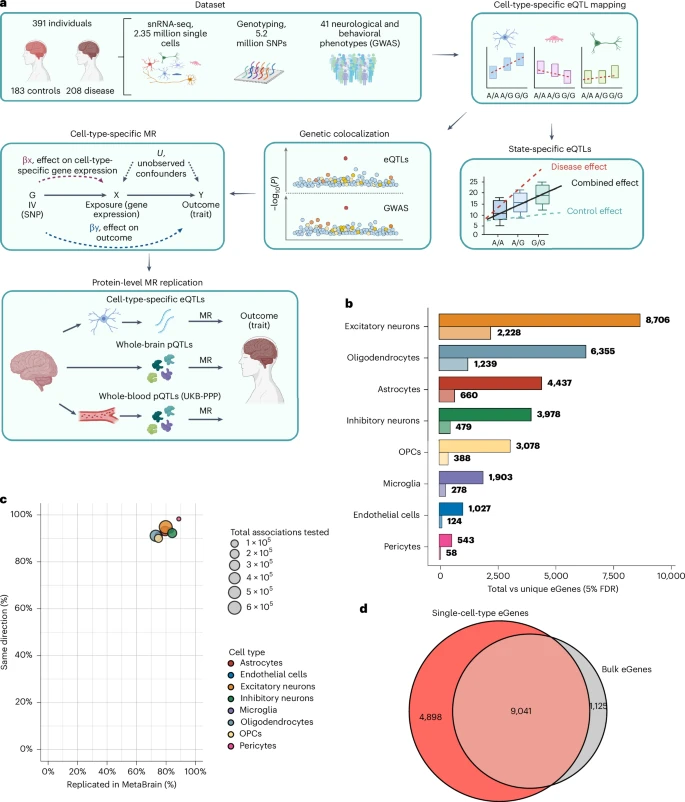
Gene expression quantitative trait loci are widely used to infer relationships between genes and central nervous system (CNS) phenotypes; however, the effect of brain disease on these inferences is unclear. Using 2,348,438 single-nuclei profiles from 391 disease-case and control brains, we report 13,939 genes whose expression correlated with genetic variation, of which 16.7–40.8% (depending on cell type) showed disease-dependent allelic effects. Across 501 colocalizations for 30 CNS traits, 23.6% had a disease dependency, even after adjusting for disease status. To estimate the unconfounded effect of genes on outcomes, we repeated the analysis using nondiseased brains (n = 183) and reported an additional 91 colocalizations not present in the larger mixed disease and control dataset, demonstrating enhanced interpretation of disease-associated variants. Principled implementation of single-cell Mendelian randomization in control-only brains identified 140 putatively causal gene–trait associations, of which 11 were replicated in the UK Biobank, prioritizing candidate peripheral biomarkers predictive of CNS outcomes.
1. 16.7–40.8% 면 생각보다 많은데 mendelian randomization 분석할 때 고려해야 하는 것 아닌가
2. Mendelian randomization 분석을 할 때 non diseased sample을 사용해야 한 다는 것을 이해할 것 (이해가 잘 안감 두 샘플에서 환자 비율이 비슷한게 좋은 것 아닌가)