Crosstalk between epitranscriptomic and epigenomic modifications and its implication in human diseases Cell Genomics
요약
Highlights
• Identification of directional crosstalk between m6A and epigenomic modifications
• Crosstalk between m6A and DNA methylation shows a global cross-tissue consistency
• Differential genomic localization between forward and reverse regulatory directions
• 2,036 GWAS loci interpreted by the crosstalk among m6A, DNA methylation, and H3K27ac
Summary
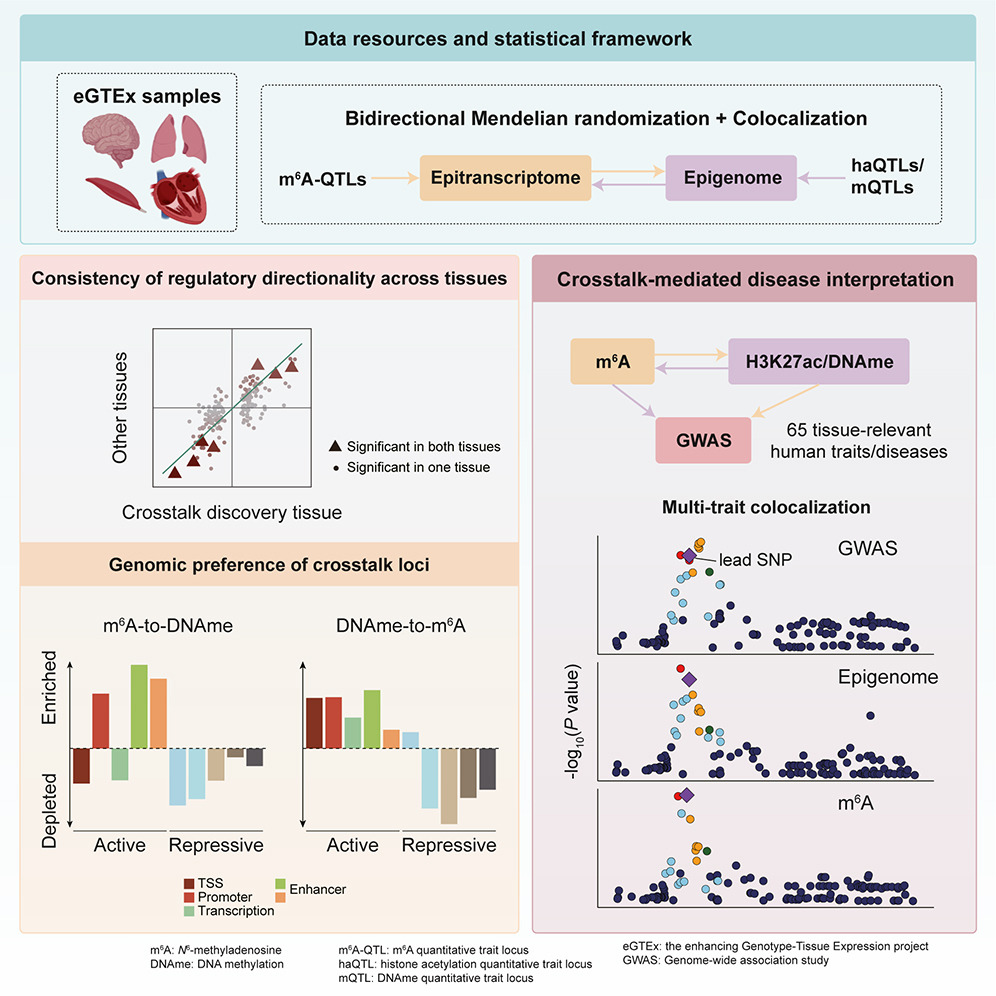
Crosstalk betweenN6-methyladenosine (m6A) and epigenomes is crucial for gene regulation, but its regulatory directionality and disease significance remain unclear. Here, we utilize quantitative trait loci (QTLs) as genetic instruments to delineate directional maps of crosstalk between m6A and two epigenomic traits, DNA methylation (DNAme) and H3K27ac. We identify 47 m6A-to-H3K27ac and 4,733 m6A-to-DNAme and, in the reverse direction, 106 H3K27ac-to-m6A and 61,775 DNAme-to-m6A regulatory loci, with differential genomic location preference observed for different regulatory directions. Integrating these maps with complex diseases, we prioritize 20 genome-wide association study (GWAS) loci for neuroticism, depression, and narcolepsy in brain; 1,767 variants for asthma and expiratory flow traits in lung; and 249 for coronary artery disease, blood pressure, and pulse rate in muscle. This study establishes disease regulatory paths, such as rs3768410-DNAme-m6A-asthma and rs56104944-m6A-DNAme-hypertension, uncovering locus-specific crosstalk between m6A and epigenomic layers and offering insights into regulatory circuits underlying human diseases.
Introduction(last paragraph)
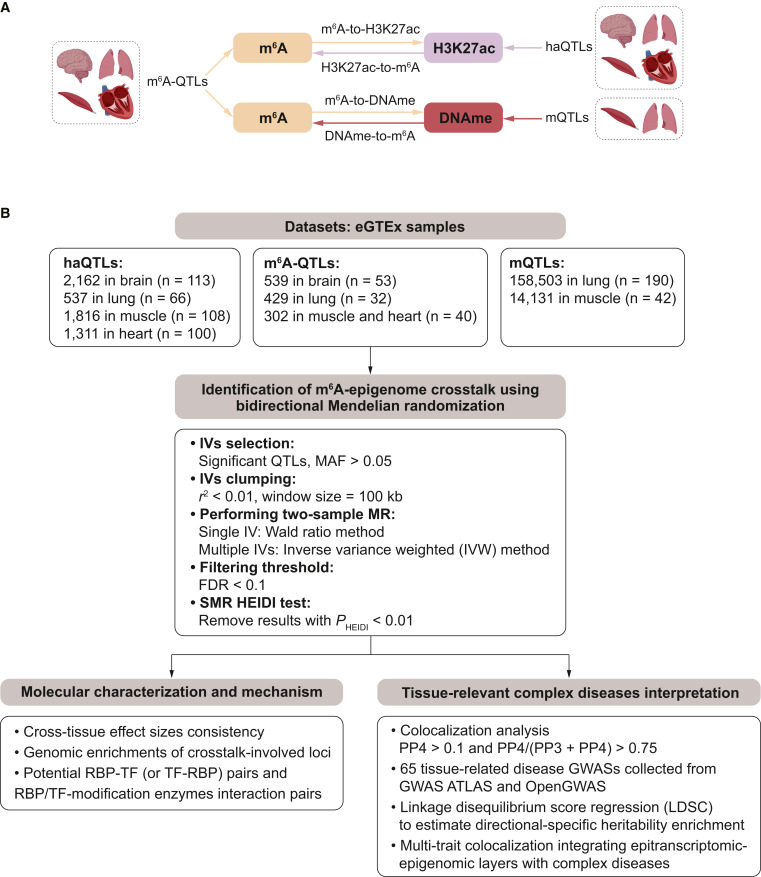
Here, we employ genetic approaches to investigate the crosstalk between m6A and epigenomic layers, including H3K27ac and DNAme. We first design a bidirectional MR framework, which is further combined with colocalization analysis, to delineate the regulatory directionality between m6A and epigenomes. We identify, in total, 153 interaction loci between m6A and H3K27ac and 66,508 loci between m6A and DNAme. The crosstalk loci between m6A and the two epigenomic modifications show global directionality consistency across tissues, suggesting the robustness of these cross-layer interactions. We observe that the DNAme sites being regulated by m6A are enriched in enhancers and transcription start sites (TSSs) and depleted in repressed chromatin regions. Mechanistically, we predict RNA-binding protein (RBP) and transcription factor (TF) pairs that potentially mediate the crosstalk between m6A and epigenomes. Biologically, we identify 20 disease loci across various brain disorders that are dependent on the crosstalk between m6A and H3K27ac in brain and 1,767 and 249 disease loci in lung and muscle traits that are dependent on the crosstalk between m6A and DNAme in lung and muscle, respectively.
*N수가 많지는 않아서 N수가 늘어나면 더 많은 causality를 발견할 수 있을 것 같음
*mendelian randomization 분석을 할 때 ancestry는 같되 겹치지 않는 cohort를 사용해야 하는 것 아니었나? 같은 eGTEX코호트를 사용한 장점이 있는지?
굼금한 점:
- 왜 Mendelian randomization을 사용했는지 (다른 분석에 비해 어떤 차별점이 있어서 )
- Complex disease와의 관련성은 medelian randomization을 사용하지 않고 multi-trait colocalization을 사용했는데 그 이유가 뭔지
- m6A와 epigenomic modifications 상호작용에 대해 구체적으로 어떤 새로운 점을 발견했는지
왜 Mendelian randomization을 사용했는지에 대한 설명? 다른 method 대비 장점은 확실히 나와있지 않음
Introduction의 내용
Recent studies have mapped the genetic associations for m6A, H3K27ac, and DNAme, generating m6A-QTLs, haQTLs, and mQTLs across various human tissues and cell lines.17,21,22,50,51,52 The availability of these QTL resources presents a unique opportunity to interrogate the causal directionality of the crosstalk between m6A and epigenomes in both tissue-specific and locus-specific contexts. In addition, integrating the genetically based crosstalk maps with GWASs bridges the mechanistic gap between genetic variants and human complex diseases.
Discussion의 내용
Moreover, a unique and apparent advantage of the MR-based approach is that we can directly link the m6A-epigenome crosstalk to human genetic diseases, therefore building up comprehensive regulatory circuits underlying these diseases. Of note, while in this study, we focused on the m6A-epigenome crosstalk in the GTEx cohort given the data availability, this strategy can be extended to other molecular traits in different populations where full summary statistics are available.
기존 연구의 한계
Introduction과 discussion에서 가장 먼저 논의하고 있는 것: 지금까지는 GWAS로 나온 variant-disease association을 해석하기 위해 eQTL만 고려했었는데 여기에 한계가 있다. 다른 여러 moleQTL을 고려하고 서로 간의 cross-talk을 고려하는 것이 중요하다는 점을 강조
구체적으로는:
Recent studies discovered that H3K36me3 histone modification and DNAme modulate the m6A methylation process, suggesting an “epigenome-to-m6A” regulation.32,33 Conversely, m6A has also been demonstrated to regulate epigenomic regulators, including chromatin accessibility, DNAme, and various types of histone modifications, representing an “m6A-to-epigenome” regulation.27,28,29,30,31 However,
1. these studies each proposed a global directionality for the crosstalk without considering the actual regulatory mode at specific loci for different tissues/cell types, hindering further functional interrogation.
2. Moreover, these studies have primarily focused on the regulatory roles of such crosstalk in stem cell differentiation and cancer progression, but its functional importance in human complex diseases has been untapped.
내가 잘 모르는 추가 분석들(일단 적어봄):
1.
protein coding 영역에서 3' upstream, 5'downstream, intergenic,,, 등등을 구분해 functional annotation을 하는 것과 비슷한 듯
Collectively, our enrichment analysis revealed that the DNAmes involved in the “DNAme-to-m6A” regulation show a global enrichment in open regions, whereas the DNAmes in the “m6A-to-DNAme” direction display a trend of specific enrichment in enhancer regions, implying a regulatory mode where m6A influences gene expression potentially through modulating enhancer activity.
2.
Potential regulator pairs mediating the crosstalk between m6A and epigenome
Despite these mechanisms exemplified, the regulators involved in the crosstalk between m6A and H3K27ac/DNAme still lack a systematic investigation. Considering the various novel RBPs recently reported to potentially contribute to m6A manipulation,21,22we next sought to prioritize RBP-TF pairs that potentially mediate the crosstalk by integrating the binding site enrichment and protein-protein interaction (PPI) maps (STAR Methods).
We first carried out enrichment analyses separately for the m6A and DNAme loci predicted to exhibit crosstalk effects by utilizing the data from the enhanced crosslinking and immunoprecipitation as well as the chromatin immunoprecipitation data available from ENCODE,64,67respectively. For the m6A-to-DNAme crosstalk pairs in lung, we identified 5 RBPs enriched for m6A, including YTHDF2, YTHDC2, and ATXN2, and 6 TFs for DNAme loci, such as AGO1, AGO2, and POLR2A (Table S6). For the reverse direction of DNAme-to-m6A pairs, we characterized 43 TFs enriched for DNAme and 29 RBPs for m6A loci (Table S6). Notably, we observed an enrichment of YTHDC2 binding for the m6A sites that potentially regulate DNAme, aligning with the m6A-YTHDC2-TET1 regulatory axis reported by a recent study (Figure S7A).65By further utilizing the PPI map curated by STRING,68we prioritized the TFs that show interaction evidence with known m6A writers or erasers, resulting in 13 TF-m6A enzyme pairs that potentially mediate the regulation of DNAme on m6A, including CBFA2T3-RBM15, DNMT1-METTL3, DNMT1-ALKBH1, and POLR2A-METTL3/METTL14/WTAP (Figure S7A;Table S7), expanding the potential regulators involved in the crosstalk between m6A and DNAme.
Considering the complexity of the m6A and DNAme dynamics, we further searched for potential regulator pairs without restricting to known writers or erasers.69,70We therefore calculated the frequency of the binding pairs for each potential RBP-TF combination that corresponds to the m6A-DNAme regulatory pairs. .... For the identified regulator pairs, we further performedin silicovalidations to assess the enrichment of the overlaps between RBP and TF binding sites in the context of mediating the crosstalk between m6A and DNAme (STAR Methods).
3.
Complex disease 관련 heritability enrichment test
We first evaluated the global heritability enrichments of m6A-DNAme crosstalk for GWAS loci using stratified linkage disequilibrium score regression in lung and muscle82,83 (STAR Methods; Tables S8 and S10). In lung, the significant DNAme-to-m6A regulatory pairs were enriched in 9 lung-relevant traits, including asthma, chest pain, wheeze, and multiple other respiratory-related traits
위 분석을 한 후 multi-trait colocalization을 함
heritability enrichment test, multi-trait colocalization, mendelian randomization 세부적인 차이점이 뭐고 왜 그 방법을 선택했는지 알아볼 것
Limitations of the study
1. Sample size 가 작음
2. We investigated the genetically predicted associations between m6A and epigenome, where the crosstalk independent of genetic regulation may not be captured. Therefore, it will be helpful to integrate both genetic-based approaches and functional experiment validations, such as the typical writer/eraser depletion-based assays, for a comprehensive mapping of crosstalk and identification of underlying mechanisms.
3. Third, the tissues/cell types and the epigenomic modification types are available for five primary human tissues at the current stage.
4. The current m6A-QTLs were confined to mRNA molecules due to the limitation of the methylated RNA immunoprecipitation sequencing methods utilized; therefore, future research is warranted to interrogate the m6A sites in the non-mRNA types, such as enhancer RNA and long non-coding RNA.